


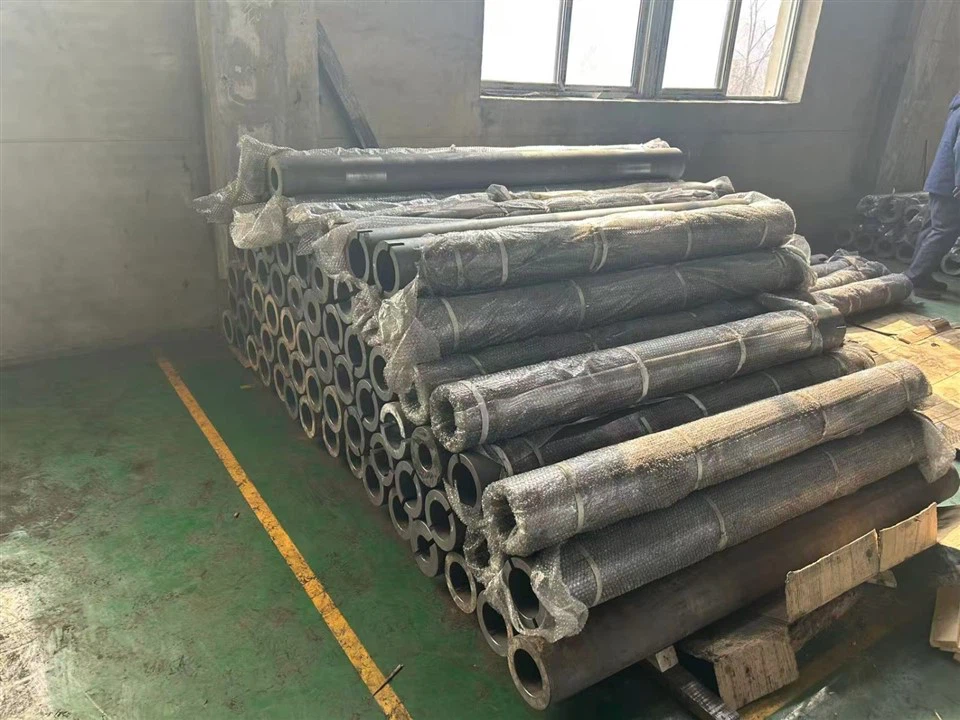
Processing Technology and Applications of Carbon Sleeves
Carbon sleeves (graphite sleeves/carbon fiber sleeves) are tubular components made of high-performance carbon-based materials, featuring properties such as high-temperature resistance, corrosion resistance, and high thermal/electrical conductivity. They are widely used in industries such as manufacturing, aerospace, and new energy. Below is a detailed breakdown of their processing technology and key application areas.
I. Processing Technology of Carbon Sleeves
1. Raw Material Selection
Graphite Sleeves: Made from high-purity graphite (ash content <0.5%) or isostatic graphite (isotropic).
Carbon Fiber Sleeves: Use PAN-based or pitch-based carbon fiber prepreg (e.g., T300/T700 grade).
2. Key Manufacturing Processes
(1) Graphite Sleeve Processing
|
Process Step |
Description |
Key Parameters |
|
Raw Material Prep |
Calcination of petroleum/needle coke → crushing & sieving (optimized particle size distribution) |
Particle ratio: coarse/medium/fine = 4:3:3 |
|
Forming |
Extrusion (tubular molds) or isostatic pressing (complex structures) |
Pressure: 50–100 MPa (isostatic) |
|
Baking |
Slow heating to 800–1200°C in a protective atmosphere for binder carbonization |
Cycle time: 15–30 days |
|
Graphitization |
Electric heating to 2500–3000°C for crystalline graphite conversion |
Resistivity: ≤10 μΩ·m |
|
Machining |
Precision CNC turning/grinding (ID tolerance ±0.05 mm) |
Surface roughness: Ra ≤1.6 μm |
(2) Carbon Fiber Sleeve Processing
|
Process Step |
Description |
Key Parameters |
|
Prepreg Prep |
Carbon fiber impregnated with epoxy/phenolic resin (resin content: 40–50%) |
Fiber orientation: 0°/90° or ±45° layup |
|
Tube Forming |
Filament winding or pultrusion (continuous fiber reinforcement) |
Curing temp: 120–180°C (autoclave) |
|
Post-Processing |
High-temperature carbonization (1000–1500°C) or graphitization (optional) |
Density: ≥1.6 g/cm³ |
II. Core Applications of Carbon Sleeves
1. High-Temperature Industrial Equipment
Semiconductor Industry:
Thermal field sleeves for monocrystalline silicon growth furnaces (CZ furnaces), withstanding >2000°C.
Gas flow tubes for SiC epitaxial equipment.
Photovoltaic Industry:
Insulating sleeves for polysilicon ingot furnaces, reducing heat loss.
2. Aerospace
Rocket Engines:
Nozzle throat liners (graphite sleeves), resistant to ablation and transient 3000°C temperatures.
Satellite Structures:
Carbon fiber sleeves for lightweight support frames (higher strength-to-weight ratio than aluminum).
3. New Energy & Chemical Industries
Fuel Cells:
Graphite bipolar plate flow field tubes (conductive/corrosion-resistant).
Nuclear Industry:
Carbon sleeves in high-temperature gas-cooled reactors, serving as neutron moderators and structural components.
4. Other Fields
Medical Devices:
X-ray machine rotating anode support tubes (high thermal conductivity, radiation-resistant).
Advanced Manufacturing:
Protective sleeves for heating elements in vacuum sintering furnaces.
III. Performance Advantages & Challenges
1. Advantages
|
Property |
Graphite Sleeves |
Carbon Fiber Sleeves |
|
Heat Resistance |
≤3000°C (inert atmosphere) |
≤2000°C (with anti-oxidation coating) |
|
Thermal Conductivity |
100–150 W/(m·K) |
5–50 W/(m·K) (axial) |
|
Strength |
Compressive strength ≥80 MPa |
Tensile strength ≥2000 MPa |
2. Challenges
Graphite Sleeves: Brittle, prone to chipping during machining (requires diamond tools).
Carbon Fiber Sleeves: Low interlaminar shear strength, necessitating optimized fiber layup design.
IV. Future Trends
1,Hybridization:
Graphite + carbon fiber composite designs (e.g., carbon fiber-reinforced graphite sleeves).
2,Precision Machining:
Laser/ultrasonic cutting for complex geometries.
3,Cost Reduction:
Chopped carbon fiber compression molding for lower-cost carbon fiber sleeves.
Conclusion
Carbon sleeves are irreplaceable in extreme environments due to their unique properties. Selection Guidelines:
High temp/conductivity needs → High-purity graphite sleeves
Lightweight/high strength → Carbon fiber sleeves
Complex shapes → Prioritize carbon fiber filament winding